Friday, September 6, 2019

How to Draft a Deck, Not a Pile of Good Cards


I love magic coaching.  

It’s the perfect marriage of my two passions, teaching, and playing with 63 x 88 mm pieces of cardboard. 

Having the past few weeks off work, I’ve been fortunate enough to be able to sneak in more coaching sessions than I usually can during the school year. At the beginning of each session, I like to ask the coachee a little bit about their magic background in order to set a baseline of who they are as a player. The questions vary from session to session, but to ensure I can give can  give actionable advice, there’s one question that I make sure to ask to every person: 

“What do you think your biggest leak or weakness is when it comes to limited?”  

In the overwhelming majority of cases, the answer that I receive is something along the lines of:

“Well, I think I have a pretty good grasp on card evaluation, but I feel like at the end of the draft I end up with a pile of  good cards rather than a deck.” 

If you can relate to that statement, I can promise you aren’t alone.  

On virtually every outlet where you can consume magic content (Discord, Reddit, Twitter, Youtube, Tinder? etc.) you can find similar sentiments:

“Draft started out strong, but fell apart by the end”  
“P1P1 took X bomb rare, but not sure where to take the draft now”  
“Middle of pack two and I have no idea how to salvage the rest of this draft, pls send help”

Today I want to explore why I think this is a commonly shared experience, and what you can do to bridge the gap between good card evaluation skills and good drafting/deck building skills. 

In short, I want to explore how to draft a deck, not a pile of good cards.

Content Creation and Our Focus on Card Evaluation 


For the most part, limited content and community discussion revolves around baseline card evaluation, card grading. Week 0 of a format is when content producers put out set reviews grading each card, week 1-2 is when the info dump of over/under-performers start to trickle in, week 3 is about the time when people have figured out where the rares and mythics sit in relation to the commons and uncommons and at week 4+ there is still no slowdown of “P1P1 which card is better” on Twitter and Reddit

Is it bad that content creation and community discussion is mostly focused on baseline card evaluation and card grading?  

No! In fact, I think it’s great.
  
There was time when access to accurate card evaluation information was semi-restricted to people who had the time to put in 30 drafts in the first two weeks or were in the know with people who had. Without a prior of accurate baseline card evaluations, its near impossible to draft anywhere close to optimally or to construct an accurate idea of what is important in each format. Card evaluation is one of the pillars of limited and without set reviews and endless online discussion, we may still be in the dark ages of people passing cards like Bag of Holding or Rotting Regisaur on day two of a GP because they look like weird cards to someone who hasn’t the time for 30 drafts before the first competitive event of a format.  

As a community in the year 2019, we have a great collective grasp on card evaluation. Anyone who wants to double check their own baseline card evaluations/card rankings can listen to the latest episode of their favorite podcast, tweet at their favorite limited specialist, or tune into an MPL member’s stream. We live in a time where access to accurate card gradings are available on demand to anyone who wants them. 

So where is the disconnect?  

In a world where card learning evaluations skills are part of limited 101 and you can crowd-source opinions from the literal best players in the world, what makes picks 2 through 45 seemingly infinitely harder than pick 1? 

I believe that due to the sheer volume of content and discussion around baseline card evaluations/ card grading, a lot of players get bogged down in the minutia of it all. There seem to be endless “is this B- card better than this B- card?” conversations, and while yes, there is usually a correct and incorrect answer, the real answer is early in the draft the cards are probably close enough that its hard to go wrong and later in the draft it depends on the context of your previous picks.

Teaching how to adjust or contextualize baseline evaluations to facilitate drafting a functional deck is a skill that doesn’t get it’s time in the sun.

Let’s Revisit Our Initial Question: How do you Draft a Deck, Not a Pile of Good Cards? 


For me, drafting a deck instead of a pile of good cards can be distilled down to two things: 

1. Understanding baseline card grades/evaluations  
2. Modifying those grades/evaluations based on context for every pick of the draft  

You must internalize that card grades, baseline card evaluations are just that. Baselines. After you’ve begun to carve out/ find your lane, your goal is no longer to identify the best card in the pack, it’s to make picks that serve the deck you’re drafting.

This isn’t a new concept but it may be for some readers, but I think it certainly bears repeating. After P1P1, sometimes as early as P1P2, grades and pick orders change based on your previous picks.

Sometimes this change is by just a hair, sometimes more dramatically. Early in the draft you should weight your picks towards the best cards in the pack until you can find your lane, but once that lane is found every pick you make should be informed by your previous picks and should contribute towards filling a role in your deck. There are times when you’re going to take Reduce to Ashes over Glint-Horn Buccaneer and Sleep Paralysis over Atemsis because that’s what your deck needs to function. If you catch your self auto-picking the best card in the pack for all of pack 2, you’re probably losing some amount of percentage points.

Using Pick Orders/Card Grades 

1. Using pick orders or card grades to take the best card from every pack in the first few picks is totally fine and helps alleviate decision paralysis. Rely on them less later in the draft when context is more important than ranking each card in a vacuum.

2. Before you can use context to modify your baseline card evaluations, you need to be confident that you have solid estimation of where every card in the set stands. This is the easy part. As previously mentioned, there are  countless outlets for you to cross reference you own card evaluations. Talk to players whose opinions you trust, send a tweet to your favorite content creator if you are unsure how good a card is in each format, ask the best player at your LGS. Don’t be shy about double checking, if there’s anything magic players love, it’s telling other people their opinions.

3. Make sure your baseline evaluations are up to date and are from informed sources. When I say “informed sources” I don’t mean “don’t ask bad players”, I mean consult sources that have of experience playing with the cards and know how the cards play in context.

LSV’s set reviews are great as starting points, but even he will tell you that 3 months into the format you shouldn’t treat them as gospel. Any set review put out before a set’s is going to be obsoleted to some degree after people get their hands on the cards. The only place to get contextually accurate card evaluations is from sources who have had hands on experience with the cards.

4. It’s ok to have a dissenting opinion on a card evaluation when compared to the masses. Drafting with preferences is something I strongly advocate for and as long as you can verbalize and rationalize why you disagree on the consensus of a card, there is no issue.


As an example, I’m a notch lower than the rest of the world on Leafkin Druid. I recognize the card is great and green is a colour that wants to ramp most times,  but I don’t take it as highly as most people because my green decks tend to lean towards aggression. This causes my baseline evaluation of Leafkin Druid  to be lower than most other people and it takes additional incentive for me to take Leafkin Druid over Rabid bite.

  
Modifiers to Your Baseline Card Evaluations

Here’s where the grading cards in context comes in. Ideally you are incrementally modifying your picks based on the context of each pack and your picks but be aware that you will mostly want to modify your evaluations:

A: Later in the draft when you have an idea what your deck needs
B: Early in the draft when a pick is close (as a basic example, you first pick Cavalier of Flame so you take Chandra’s Outrage over Murder P1P2)

Here are some common pick order modifiers that you can put into practice.


Modifying Grades Based on Archetypes

It's important to know what cards each archetypes want and what cards they don't. Many formats have "secret gold cards" cards, mono-colored cards that really only belong in one or two colour pairs. This is more common in high synergy formats that have decks that want to be linear or more streamlined. Most Ravnica sets are a pretty good example of this. 

It's early in pack 2 and you're solidly in Izzet

Direct Current (GRN)Goblin Electromancer (GRN)

You're faced with the choice between these two cards so you check their grades

Wojek Bodyguard (GRN)                                   

               C+                                                                            C

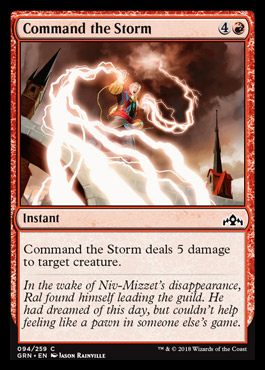
If you took bodyguard in this spot because its "the best card in your colors" you'd be making a reasonably bad pick. Most Izzet decks in GRN ended up with sub-13 creatures making Wojek Bodyguard a liability. While a worse card early in the draft, Command the Storm is a better pick in this spot because of how linear GRN archetypes were.

This concept applies to low-medium synergy sets as well, but picking the "wrong" card won't be as punishing.

We're in the middle of pack 2 of a M20 draft and you're solidly in UB control

Scholar of the Ages (M20)Agonizing Syphon (M20)Boreal Elemental (M20)


You're faced with the pick between these two cards

Audacious Thief (M20)                                            

                C+                                                                                  C+

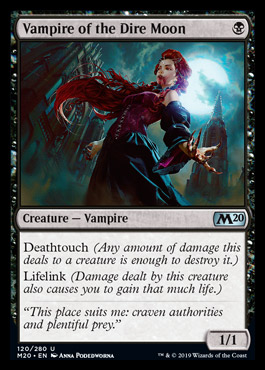
I consider Audacious Thief to be the slightly better card P1P1 but would take Vampire in this spot. With the cards I have in my pile, i'm less likely to include cards in my deck that facilitate attacking profitably with the Thief .  However, unlike the GRN example, I don't think it would be an egregious mistake to take Thief. While your UB deck has a generalized plan, M20 decks usually aren't so focused that they can't make uses of generically good cards that don't quite fit their plan.

The takeaway here is that you should have a good understanding of how synergistic/linear decks in a given format are and know how heavily to weigh picks based on what archetype you're in. In high synergy formats slight discrepancies in grades between cards can be amplified and taking a card that is not conducive to what your deck wants to do can be punishing.


Modifying Grades Based on Pockets of Synergy 

"Pockets of synergy" is a term I like to use to describe groups of cards that have high synergy with each other in an otherwise low synergy deck. Drafting pockets of synergy is a way to boost the overall power-level of your deck when you don't get the nuts GR elemental deck or don't end up with 3 great rares.

M20 is home to one of my favorite pockets that I affectionately call the Fantastic 4

Scorch Spitter (M20)

Most of these cards are fine on their own, but when you have say two copies of each in your deck, they give your deck a dimension other than "good cards in my colour."  Drafting pocket of synergy is one of the key ways that you can draft a deck, not just a pile of good cards.
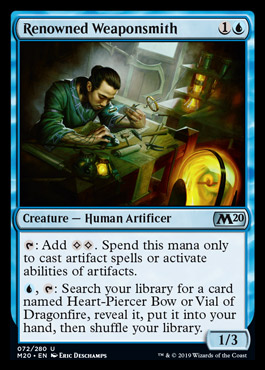


Renowned Weaponsmith + Bow/vial is another great example of a pocket of synergy, but with I challenge you to look even further than the obvious synergies written on the card. With enough copies of Weaponsmith, you can extend this (make you pocket bigger??) by including cards that normally wouldn't make your main deck but become actively good when you can reliably have a Weaponsmith.

Stone Golem (M20)Anvilwrought Raptor (M20)

Let's say its Pack 3 and you're an aggressive red black with three Chandra's Outrages and two Lavakin Brawlers among your other cards.


You're faced with this pick, Outrage vs your first Chandra's Ember cat


               B+                                                                                            C


There is a huge discrepancy in P1P1 power-level here, but I'm just taking Embercat almost every time here.  You just don't need to take the Outrage here, the fourth copy doesn't facilitate your aggressive plan better than Embercat potentially casting turn three Lavakin Brawler. Removal is great but there is 100% a such thing as too much removal, and you want to draft a deck that is greater than the sum of its parts.

Modifying Grades Based on Two-Card Interactions 

This is similar to pockets of synergy, just on a smaller scale. When you have Destructive Digger or maybe Renowned Weaponsmith in your pile, consider picking up that 10th pick Retributive wand, as it's worth putting slightly conditional cards in your deck in exchange for powerful two card interactions.

Destructive Digger (M20)   Retributive Wand (M20)

Mask of Immolation and Act of Treason is another good example of this

 Act of Treason (M20)

Knowing a formal rather intimately is rewarded here. Getting familiar with the cards in each format means you'll be more aware of interactions like this, and you'll have a good sense of when it's worth putting a card like Wand or Act of Treason in your deck. There are times when you see cards that may look like they fit this description but just end up being traps.


Filling in Holes in Your Deck 

The two most common holes that need to be filled are a need for interaction, and a need to lower your curve. Once you're late into pack 2 or opening pack 3, baseline grades nearly go out the window if you have holes in your deck that needs to be filled.  As I mentioned before, there are times when you’re going to take Reduce to Ashes over Glint-Horn Buccaneer and Sleep Paralysis over Atemsis because that’s what your deck needs to function.

Let's look at this pick from pack 3 of this aggressive RW draft


Both Lavakin Brawler and Scampering Scorcher are markedly better cards than Chandra's Embercat but in this spot I'm taking the cat. We already have a ton of 4's already and would like to enable turn three Lavakin Brawler.

Here's another example except this time, we're choosing between a removal spell and a great creature.

Image

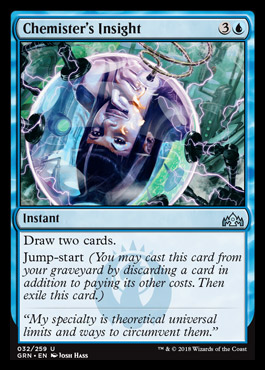
If I was leaning towards UB early in the draft and was faced with this pick, I'd take Tomebound Lich over Murder. However, at this point in the draft we've already got a bunch of quality creatures and are in desperate need of another piece of interaction. I honestly think if the pick here were between Murder and Cavalier of Gales, I'd take the Murder. We have good top end and upgrading our finishers doesn't do as much for this deck as adding another removal spell.


Takeaways


  • To successfully draft a deck and not a pile of good cards, you need to keep your pick order fluid
  • Always be re-evaluating your picks and contextualizing cards based on what you already have
  • Be smart about pick orders, they're a great tool, but use them as baselines, not absolutes
  • Look for pockets of synergy to draft a deck that's greater than the sum of its parts
  • To make the most informed picks, educate yourself about the format so that you are cognizant about archetypes and card interactions
  • You should be deck building as you draft. You don't want to end up in a spot where at the end of the draft you have a pool of cards and go "ok now how do I build this?" outside of  changing cards 20-23

Thanks for reading !


Wednesday, July 31, 2019

The Do’s and Don’ts of M20 Limited – What I’ve learned from 100 drafts

Chandra, Awakened Inferno (M20)

I have to start by giving a huge round of applause to the WotC Set Design and Play Design teams for making the return to core sets a huge success in terms of creating deep and engaging limited environments. M19 certainly had its detractors (I was not one of them, that set was great) but the general consensus for M20 is that it’s the best core set limited environment of all time.

I’m officially 100 drafts in and each time I crack my packs, I find i'm still  presented with interesting decisions in both in the draft and during the games. One of the things that makes a limited format engaging for me is watching it transform and discovering how my initial evaluation of cards and archetypes evolve and change as I play with the set. The items on this list of do’s and don’ts are reflective of how these evaluations have changed from draft 1 to draft 100. Many of them highlight my level-up moments in the format, times when I discovered a leak in how I had been approaching the format and how I subsequently changed said approach, leading to a better conceptualization of the format as a whole. Let’s jump in!

Do #1: Do take Cloudkin Seer over Murder P1P1


Murder (M20)

When I first saw Cloudkin Seer on the day it was previewed, I literally did a double take, zooming in on my phone to make sure that I was reading  it correctly. Cloudkin Seer harbors an absurd amount of power for a three-mana common creature. Cloudkin Seer wins the Quadrant Theory test, the entire thing. It’s exactly what you want at every stage of the game. It’s card advantage without tempo loss, it’s a threat, it trades off well, it’s cheap, it generates velocity and, to top it all off it has a set-relevant creature type. I don’t think it’s a stretch to say that it’s the best common printed in a standard set since Mulldrifter in Lorwyn.


As amazing as Cloudkin Seer reads on first blush, it wasn’t immediately obvious that it was the best common in the set. In a alot of formats, the best commons are just the removal spells and with M20 continuing the trend that War of the Spark started, a return to efficient removal at common, thar seemed likely to be the case for M20.

Murder is the poster child for efficient removal spells in M20, and a card that I know many players had as the best common going into the set. However, as the format went on, it became clear to many players including me, that even though Murder is very good, Cloudkin Seer just checks too many boxes and is too rawly powerful to not earn the title of best common.

Murder is great, don’t get me wrong (also wow, FBI guy watching my computer, it’s not what it looks like) but there are a good handful of spells in the set that approximate what it does. Pacifism, Chandra’s Outrage, Shock, and Rabid Bite are all great removal spells and while they aren't quite on the level of murder, they fill the same taxonomic role in your deck that Murder does. The reason that Cloudkin Seer gets my vote for the best common is that no other common comes close to what it does and how well it does it. Irreplaceability is a big factor is how highly you should take a given card P1P1 and Cloudkin Seer happens to be at top of its class in that regard. On top of how good the card is in a vacuum, M20 is a particularly kind environment to Cloudkin Seer, as there are a bunch of ways to recur your creatures, and cards that reward you for certain features of the card like the flying/elemental synergy cards.

You can take Murder over Cloudkin Seer P1P1 and you won’t have made a terrible mistake, but I do think that it is the less powerful card and that you’re giving up some percentage points by doing so.

Don’t #1: Don’t look to the wedge archetypes to tell you how to draft each colour pair.


efore a set comes out, WotC usually publishes a list of the intended archetypes/ strategies for each colour pair. For M20, they took a pretty novel approach to this, where instead of designing linear strategies around two-colour pairs, the archetypes were more loosely focused and designed around the 5 wedges al la Khans of Tarkir.

The prescribed archetypes are as follows:

·       Flying (blue-red-white)

·       Elementals (green-blue-red)

·       Go Wide (white-black-green)

·       Aggro (red-white-black)

·       Control with "Enters-the-Battlefield" Effects (black-green-blue)

Most of these make a lot of sense and play out closely to how they are presented. In UG, UR and RG, you’re paid off for having a lot of elementals in your deck and in UB, BG and UG, you want to grind and many of your payoff creatures have impactful ETB effects. On the surface, it seems the descriptor tells you what you want to do while drafting and what your deck wants to do, however as you dig a bit deeper some problems arise.


When I’m learning a new format I want to have a very clear idea of what each colour pair wants to do so that I know where to prioritize certain cards in the draft and figure out what mono colours commons are secretly gold cards (for example, Ferocious Pup isn’t a card I ever really want in RG but it can be a fine role player in GB and WG.) After a few drafts, I realized that the wedge descriptors weren't really giving me what I needed to wrap my head around what each colour pair wanted to do. 


Ferocious Pup (M20)

GB is a grindy deck with good ETB’s, ok that makes sense, but wait, it also wants to go wide? RW is an aggro deck but also a flying payoff deck? What are my payoffs here? A white removal spells that aggro decks don’t want and a medium at best two drop?


Aerial Assault (M20)

The problem here is that some or the enemy pairs are much more aligned with one strategy than others. GB for example is much more “Sultai Grind” than it is “Abzan go wide” and RW is much more of an aggro deck than one centered around flying. To account for this, you need to adjust your picks and evaluations accordingly. If you were drafting M20 for the first time and saw that GB was part of the “go wide” wedge, you might think that a card like Overcome exactly what the deck wants, but that’s usually not the case.

Here’s a quick rundown of what I consider to be the true archetypes for each colour pair

UW: Flying synergy
UB: Grindy Control/ Scholar of the ages loop decks
UG: Elementals/a base for 3-5 colour good  stuff
UR: Aggro/Tempo, the only real Elemental payoff is Lavakin brawler and the only flying payoff is Winged Words, don’t focus too hard on either theme, just have a solid aggressive deck
BG: Grindy control, Mouldervine Reclamation.dec
BW: Go wide with Corpse Knight and Gruesome Scourger as payoffs or lifegain matters (reliant on uncommon payoffs to be good)
RW: Go wide aggro, raise the alarm based
GW: Go wide aggro, raise the alarm based
BR: Midrange grind. Not really an aggro deck. Good removal but black’s threats are generally weak, the deck can be more aggressive if you are red based
RG: Elementals with the highest density of payoffs

Do #2: Do take the X and Y colour hoser cards higher than you are now

M20 presents us with this cycle of extremely powerful colour hosing spells

Noxious Grasp (M20)Devout Decree (M20)Fry (M20)Veil of Summer (M20)Aether Gust (M20)


A month into the format, these cards are still going close to last in too many MTGO pods. It seems that most people are taking these cards in the spot where they would take traditional sideboard cards like Disenchant or Shatter ( or possibly just taking middling maindeck playables over them) but you can meaningfully improve your card pool by ending up with 3-4 of these cards in your sideboard. Being able to bring in a couple A-level removal spells in relevant matchups grants a gigantic boon to your win percentage.

I’m taking these cards above C level playables in pack 1 and 2, and then above C plus/ Some B minus cards in pack 3 once you know for sure what colours you’re in. Remember, at least 50 percent (and on average, more than that) of your games are played post sideboard. Having a strong main deck is important but don’t underestimate the power of having a strong post-board plan.

Don’t #2: Don’t play the Cavaliers ( or other hard to cast cards) if your manabase can’t afford them 


Cavalier of Thorns (M20)

The cycle of elemental Cavaliers are some of the most powerful cards in the set, but as a foil to that, they’re costed accordingly. To play them responsibly, you need at very least 9 sources of the requisite colour needed to cast them, and ideally 10-12 if you want to cast them on turn 5. If you don’t meet that requirement, you should seriously consider not including them in your deck, as you risk not being able to cast them in a timely fashion. Conversely, if the rest of your deck is mainly a colour that the Cavalier is not, you can’t afford to play a bunch of lands that don’t cast the majority of your spells to try to accommodate your sweet mythic. This also applies to the CCC cycle of rares in M20 (Gargos, Villis, etc.)


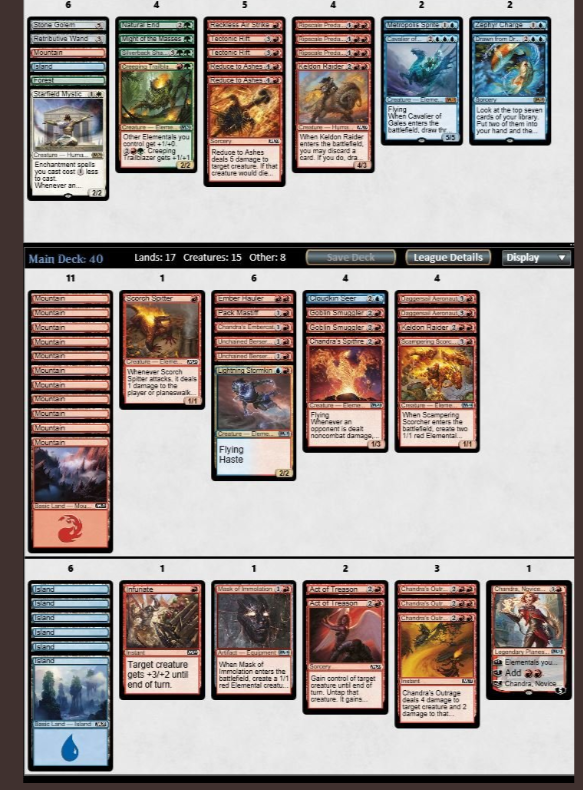
This deck from Twitter user @KaptainMeliodas really illustrates this point. There’s no way that they could have put more blue sources into their deck without royally messing with their ability to cast their red spells, meaning the Cavalier stays int he board. Limited manabases are poor by nature, putting additional stress on them with irresponsible builds usually loses you more EV than it gains.


Do #3: Do pick dual lands and evolving wilds over C level playables


Evolving Wilds (M20)

Trailing off of the previous “don’t” point, limited mana bases inherently are much worse than most people give them credit for. The standard 8-9 split manabase has you drawing lands and spells that don’t match an alarming amount of the time (I highly recommend checking out Frank Karsten’s articles about building manabases if you want to check out the numbers and haven’t already)

M20 blesses us with fixing at common that doesn’t take up a spell slot. Take advantage of this 
opportunity and strive to build a good manabase. Having 2-3 dual lands in your deck improves your manabase substantially, meaning succumbing to variance less often and even having to mulligan less.

Don’t #3: Don’t mis-evaluate these cards
I specifically bring up these cards because I see them go later than they should (by a lot in some cases)

Mask of immolation: This card is great, and I’ve seen in wheel in pack 1 with some amount of consistency which should basically never happen. Mask does a lot of small things that add up to one very good card. The initial ping usually kills a small creature and from there you can use your more irrelevant creatures to kill fliers or just finish off your opponent. In addition to its surface level uses, the card really loves Chandra’s Spitfire, Sanitarium Skeleton, and Act of Treason. I take my first Mask over my first Shock/Chandra’s Outrage, it’s on power level with the removal spells but is less replaceable  


Mask of Immolation (M20)

Chandras Regulator: A lot of early set reviews poo-poo’d this one, but in a deck with 9 + mountains, the card does a good Merfolk Looter impression and with 2 Chandras in the set trinket text comes up a good amount


Chandra's Regulator (M20)

Loxodon Lifechanter: I think the secret is mostly out on this one but a bit earlier in the format I was getting passed this card in pack 1. This card is busted good and even if you have an aversion to white, it’s a great splash card.

Loxodon Lifechanter (M20)


Golos: I would say the secret about Golos is also out but this one I do still get passed to me in pack 1. Golos is great and worth building around, one activation is usually game over and a lot of decks will play him even if they can’t activate him.  


Bag of holding: This is just a good card advantage engine; I have this as better than every common/uncommon P1P1 except Chandra Novice Pyromancer (Risen Reef is up there too but colourless>gold)

Bag of Holding (M20)

Do #4: Do take Pattern Matcher early and play it even with one match

Pattern Matcher (M20)


Pattern matcher is a card I’m happy to take early out of a pack that doesn’t have any premium commons or uncommons. Four mana 3/3 is a reasonable stat-line in this format and drawing a card off this card is pretty common with just a little bit of good deck building.

Playing pattern matcher with only one potential match in your deck is still fine, as drawing a card from it is such high upside, and the floor of the card isn’t embarrassing.


Don’t #4: Don’t be ROTY about Rotting Regisaur

Rotting Regisaur (M20)

Rotting Regisaur has created more polarizing opinions than any other card I can remember. I’ve heard players whose opinions I respect say that the card is a P1P1 over every common and uncommon, and others saying its hot garbage. This discrepancy of opinions makes sense as how good the card varies greatly from game to game. Sometimes you play it on turn 3 and you opponent loses on turn 6 and sometimes it gets Pacified and you basically lose on the spot.

I’ve personally landed somewhere in the middle on the card. I take it early and almost always include it in my deck with the understanding that it will lose me the game sometimes and that’s ok. Whether you decide to draft/play Rotting Regisaur is up to you, but the important thing to remember is that when you put the card in your deck, you’re accepting that the card has a massive range for how well it performs and that its neither amazing nor awful based on the small sample of games you play with it.  Just like every card we evaluate, Rotting Regisaur should be evaluated based on its floor and ceiling and is never a fixed point on that scale.

Do #5: Do draft white when it’s open

I think white kind of got a bad rap early in the format that it never quite shook. It’s certainly the worst colour in the format but by a fair margin, but it’s not quite at the “avoid at all costs” level where I’ve seen some people have it. White’s commons are under-powered when compared to the other colours, but it is among the strongest colours when you look at the higher rarity cards.

Ancestral Blade (M20)Master Splicer (M20)

I’m not looking to move into white early, but if I’m seeing quality cards like Griffin Protector wheeling, I’ll make some late speculative white picks and see if I get passed some of the better cards in later packs. White being perceived as awful is a boon for drafters willing to speculate on it as you’ll often get passed A level cards from people that are trying to avoid the colour at all costs. 

Griffin Protector (M20)

Since white is bad at attacking on the ground, a successful white deck needs to be at least one of the following things

1. A Raise the Alarm style deck with anthem effects

2. A deck that has white as its secondary colour, cherry picking the best cards from the colour (Pacifism, good uncommons/rares)

3. A deck that lucks out and just has very high card quality (usually meaning you’re the only white drafter at the table, which happens semi-regularly

Don’t #5: Don’t be Midrange


If you’ve listened to Lords of Limited, this is something that you’ve already heard, but I do want to echo it here. M20 has insanely powerful deck at both ends of the spectrum; Mono-red decks that are looking to kill you on turn 5 and Decks that want to grind until turn 15 and lock you out of the game by looping Scholar of the Ages.

Being caught somewhere in the middle isn’t somewhere that I’m really looking to be if I can help it. This isn’t to say that midrange decks can’t be good, more that for them to compete with decks on either end of the spectrum, they need high card quality to not just get demolished by a deck with a more streamlines plan.

I leave you dear reader with my M20 card rankings from 17lands.com for anyone who wants to compare card evaluations. It’s a great tool and I highly recommend using it. https://www.17lands.com/card_tiers/shared/371b8cbf6c864cbcb330c1273fd5271f

24 Theros Beyond Death Trophies with 24 Draft Logs and an Update to the Ultimate Draft Guide

Alex Nikolic (Chord_O_Calls) If you haven’t checked out my recent  10 000 word THB draft guide posted on draftsim.com, I’d reco...